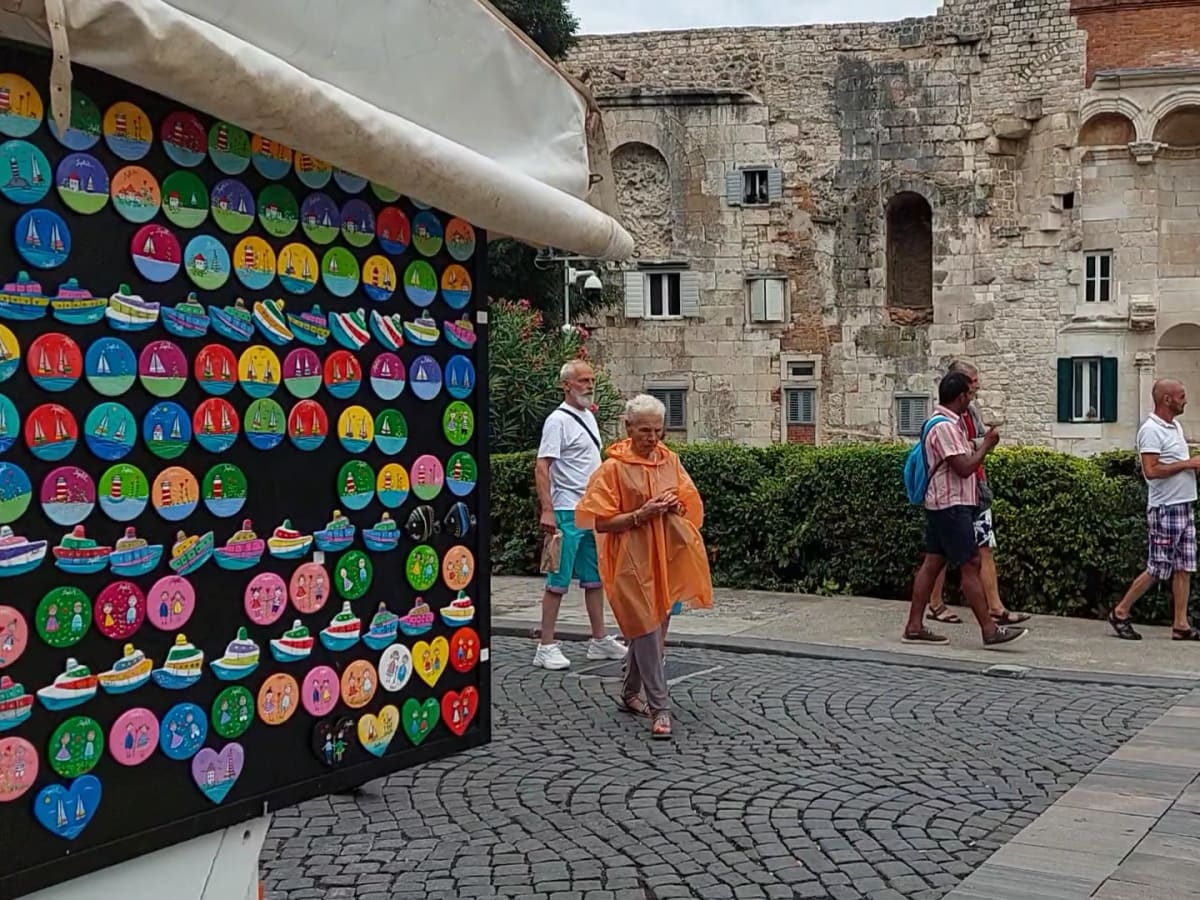


Most old towns are a district. Split's is a building. What people call the Old Town here is Diocletian's Palace, a retirement compound finished for a Roman emperor around the year 305, roughly two hundred metres across, and the reason the whole thing still works is that nobody ever left. When the empire receded and Salona up the road was abandoned, its people moved inside these walls and stayed. Sixteen centuries later there are flats above the Roman arcades, a bar in a guardroom and somebody's washing hanging across a lane the emperor's staff used.
That is the thing to hold onto as you walk it. This is not a ruin with a ticket desk. It is a working quarter that happens to be built inside a palace, which is why the good hours here are the ones when the residents outnumber everyone else. The route below runs clockwise from the north gate and finishes above the town for sunset, because the light at the end of the day is not optional and everything else is easier to arrange around it. At a normal pace with a long lunch it fills a day; briskly it is a morning, which is what a ship's passenger gets.
Start at the Golden Gate
Come in from the north, through the Porta Aurea. This was the emperor's own entrance, because the road behind it runs to Salona where he was born, and it is the grandest of the four: a double gate with a courtyard between the arches, empty niches above where statues stood, and a relieving arch over the lintel that is the piece of engineering worth stopping for.
Outside it stands Ivan Mestrovic's Gregory of Nin, four and a half metres of tenth-century bishop with a raised finger and one toe rubbed to gold by people who have been told that touching it brings luck. Whether it does or not, the queue for the toe tells you how the day is going to go: if there is no queue at nine, you have chosen your hour well.
The Peristyle
Walk south through the quarter and the lanes open into the Peristyle, the colonnaded court that was the forecourt to the imperial apartments. The granite columns were shipped from Egypt, and so was the black sphinx at the southern end, which was already about fifteen centuries old when it arrived here. There were originally a dozen of them around the palace; this is the one that survived intact, and it has now been in Split longer than it was in Egypt.
This is the middle of the town in every sense. People sit on the cathedral steps with a coffee from the bar in the corner, a klapa group sings under the vault behind, and the whole space is free and open at any hour. Come back after dark before you leave: lit from below, with the stone still warm, it is a different place entirely.
The cathedral and the bell tower

The octagonal building on the east side of the Peristyle was Diocletian's mausoleum. It is now the Cathedral of St Domnius, dedicated to a bishop the emperor had executed, which is the sharpest irony on this coast and worth a moment before you go in. Inside, the emperor's own frieze runs above the columns, and the carved wooden doors are Andrija Buvina's work of 1214, twenty-eight panels of the life of Christ in walnut.
The bell tower alongside is the climb, and it should be done first thing. The stairs are open stone, steeper than they look from below and not for anybody uneasy about heights, and the top is the one place that puts the Peristyle, the tiled roofs, the harbour and the islands into a single frame. The queue builds through the day and it closes earlier than you expect in the shoulder season, so this is the stop that decides the shape of your morning.
Down into the cellars
From the Peristyle, go down. The substructures beneath the southern half of the palace held up the emperor's apartments, and because they were filled with household rubbish for centuries they survived better than almost anything above them. Cleared out within living memory, they now give you the floor plan of rooms that no longer exist overhead.
The central passage runs straight through to the Riva and costs nothing to walk; it is lined with stalls, and on a July afternoon it is the coolest place inside the walls. The ticketed halls on either side are where the real vaulting is, and where the space is big enough to make you understand the scale of what stood on top of it.
Jupiter's Temple and the lanes behind
Off the western side of the Peristyle, down a lane so narrow that two people pass sideways, a headless sphinx guards the door of Jupiter's Temple. The building became a baptistery, and it holds an eleventh-century font carved with a Croatian king on his throne, the earliest surviving image of one. Mestrovic's John the Baptist stands behind it. Look up before you leave: the coffered barrel vault is original Roman work.
Then get deliberately lost for twenty minutes. The residential lanes of the palace are the part most day visitors miss entirely, and they are the point: a doorway cut through a fourth-century wall, a cat asleep on a Roman step, a woman leaning out of a window three floors up to talk to somebody in the street.
The green market, if it is still morning
Out through the Silver Gate on the east side, the Pazar spreads across the open ground under the walls. Fruit and vegetables from the hinterland, cheese, olive oil, honey, dried figs and homemade rakija, mostly sold by the people who grew or made it.
Twenty minutes here changes how the rest of the day reads, because every menu you look at afterwards is drawn from what you have just seen on the stalls. It is also the answer if you are self-catering: this and a bakery will feed two people for less than one restaurant lunch.
Narodni trg, the fish market and lunch
Leave through the Iron Gate on the west side and you are on Narodni trg, which nobody calls that either; it is Pjaca, and it has been the civic square since the medieval city outgrew the palace. The old town hall stands on the north side with its Gothic arcade.
Keep going west and you reach the Peskarija, the fish market, which is the stop people are most surprised by. It is a covered hall of marble slabs with the morning's catch on them, in the middle of a city, and it famously has no flies: the sulphur spring next door keeps them away. Whether that is chemistry or folklore, the absence is real enough to notice.
For lunch, walk up into Varos behind it. This was the fishermen's quarter, single-storey stone houses on stepped lanes too narrow for cars, and the konobas tucked into it are where Dalmatian home cooking carried on while the palace filled with cruise passengers.
Up Marjan for the last hour
Split's advantage over every other walled town on this coast is that it has a hill, and the hill is free. From the top of Varos, a stone stairway climbs to the first terrace on Marjan in about twenty minutes at a steady pace, rather longer in August heat. From there you are looking straight down on the palace roofs, the harbour, the ferries coming in and the islands beyond them.
Marjan is a planted forest rather than a surviving one: the pines went in from the late nineteenth century onto a hill that had been stripped for firewood, and a society formed in 1903 still shapes the park. The paths run on along the ridge to the summit at a hundred and seventy eight metres, and down the southern side to the coves at Kasjuni and Bene if you have brought a towel.
Arrive at the first terrace about forty minutes before sunset. Twenty minutes before, there is nowhere left to stand.
If you have an hour more
Two things sit just outside this route and both reward the detour. The Mestrovic Gallery is out along the Marjan slope, in the villa the sculptor built for himself, and one ticket usually covers the Kastilac chapel further along the road. And Bacvice, ten minutes east of the palace, is the city beach: sand rather than pebbles, shallow enough to walk a long way out, and the home of picigin, a game of keeping a small ball out of the water with open palms that locals play year round, New Year's Day included.
Practical notes
The palace quarter is entirely pedestrian and no vehicle reaches most doors, so if you are staying inside the walls, expect to carry your bags the last few hundred metres from a garage or the harbour.
Cruise ships berth on the eastern arm of the harbour, about a ten-minute walk from the palace along the water, which is unusual: most ports on this coast need a shuttle. The coach station and the railway platforms stand on the same quay, so an island day and a journey inland both start from the same spot.
The heaviest hours inside the walls run from late morning until about three, when the ships and the coach circuits overlap. First thing and the hour before sunset belong to the people who live here, which is exactly why this route puts the tower early and the hill last.

